


Quick Answer
To choose the right rubber diaphragm manufacturer, evaluate eight things: material and compound expertise, customization depth, quality certifications (IATF 16949, FDA, REACH, RoHS), manufacturing process control, industry-specific experience, reinforcement capabilities, in-house testing, and delivery reliability. A supplier who scores well across all eight isn’t just a vendor — they’re a production risk you’ve already managed.
You didn’t search for this because you’re curious. You’re here because sourcing the wrong rubber diaphragm — or the wrong manufacturer — has consequences.
Maybe a diaphragm failed earlier than it should have. Maybe a supplier sent the wrong hardness and your customer found out before you did. Maybe you’re setting up a new supply chain and can’t afford a six-month trial-and-error cycle. Whatever brought you here, this guide is written for people who are past the research stage and need to make a confident, final decision.
No filler. No generic manufacturing content. Just the eight things that actually separate a reliable rubber diaphragm manufacturer from one that will cost you more than they save you.
1. They Know Your Application — Not Just Rubber in General
This is where most buyers make their first mistake. Rubber manufacturing is a broad field. A supplier who makes door seals and windshield gaskets is not automatically equipped to produce a precision fabric-reinforced diaphragm that cycles a million times in a fuel pressure regulator.
The question isn’t “do you make rubber diaphragms?” — every manufacturer will say yes. The question is: have you solved this problem before, in this kind of application, with these operating conditions?
For instance, a diaphragm used in an LPG/CNG regulator has to be ultra-thin (sometimes as thin as 0.20 mm), fuel-resistant, sensitive to micro-pressure changes, and have zero tolerance for inconsistency across thousands of production cycles. That’s a completely different engineering challenge compared to a large-diameter windmill diaphragm that needs to handle high mechanical pressure in an outdoor environment.
When you’re evaluating a manufacturer, ask them to walk you through a project they’ve done that’s closest to yours. Not a product category — a specific project. What was the application, what material did they use, what problems came up, and how did they solve them? Their answer will tell you more than any brochure.
2. Material Selection Is a Consultation, Not a Catalogue
A diaphragm is only as good as its compound. And getting the compound right means understanding your operating environment in detail — the media it contacts, the pressure it handles, the temperature it lives in, and how often it moves.
NBR (nitrile) works well with oils and fuels but has limits in ozone-heavy environments. EPDM handles steam and water-based media brilliantly but won’t last in petroleum contact. FKM/Viton® is the go-to for aggressive chemicals and high heat but costs more. Silicone is excellent for extreme temperature ranges but has low tear resistance in high-cycle applications.
The right manufacturer doesn’t hand you a datasheet and ask you to choose. They ask the right questions first — and then they tell you which compound to use and why.
This is why understanding rubber’s physical and chemical properties matters in the conversation you have with a supplier. If they can’t explain the tradeoffs between materials in plain language, their formulation process is probably not as controlled as it should be.
At DS Rubber, compound mixing happens in-house with automated weighing systems — meaning every batch is formulated to the same specification, not approximated. That consistency is what makes a diaphragm perform the same way in part 1 and part 10,000.
3. Certifications Aren't Just a Checkbox — They're Process Evidence
Let’s be direct: a quality certification on a manufacturer’s website is meaningless unless it’s current, independently audited, and actually applied to the production of your part.
For most industrial and automotive buyers, the minimum bar is IATF 16949 — the automotive sector’s quality management standard. It’s not easy to earn, and it’s harder to maintain. It requires documented control plans, measurement system analysis, statistical process control, and regular third-party surveillance audits. When a supplier holds this certification, it means they’ve built quality into their process — not just checked for it at the end.
Beyond IATF, look for:
- FDA compliance if your diaphragm contacts food, water, or pharmaceutical media
- REACH compliance if you’re supplying into European markets — this covers chemical safety of the rubber formulation itself
- RoHS for applications in electronics-adjacent industries
DS Rubber is IATF 16949:2016 certified through TÜV NORD CERT GmbH and produces FDA, REACH, and RoHS compliant diaphragms. These aren’t historical credentials — they’re maintained through ongoing audits. You can see the full certification details on our certifications page.
If a manufacturer can’t tell you who audited their certification and when the last audit was, that’s a problem.
4. Can They Actually Build What You Need?
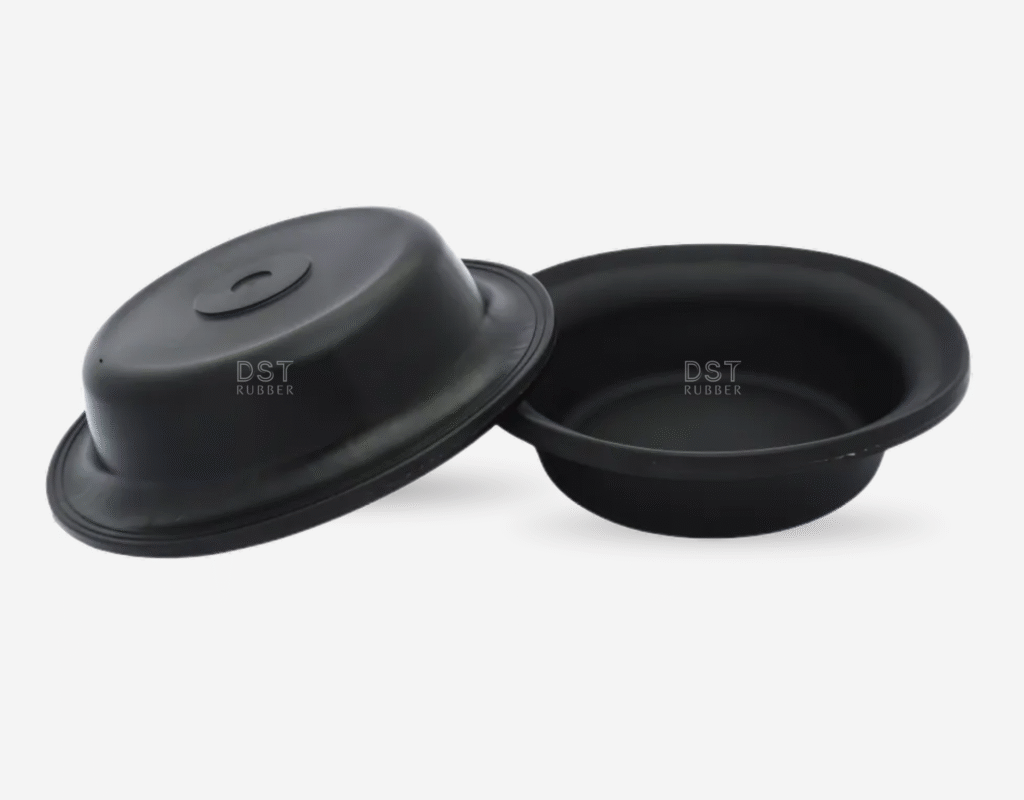
The range of diaphragm types in industrial use is wider than most buyers realize. Flat diaphragms. Convoluted diaphragms. Rolling diaphragms. Sealing diaphragms. Dual-layer composites. Perforated configurations. Each serves a fundamentally different mechanical purpose.
And within each type, the customization requirements can be demanding: specific durometer, tight dimensional tolerances, embedded fabric or metal inserts, bonded flanges, or surface finishes optimized for sealing.
Here’s a practical test: describe your application — the housing it fits into, the pressure it handles, the fluid it contacts, the cycle rate — and ask the manufacturer what type of diaphragm they’d recommend and why. A good manufacturer will give you a specific answer with reasoning. A weak one will show you a product range and ask you to pick.
The types of rubber diaphragms DS Rubber produces span from simple flat membranes to complex multi-layer reinforced configurations with metal or fabric inserts — sized anywhere from ¼” to 55″ in diameter. For valves and actuators specifically, the combination of precise geometry and chemical compatibility requirements demands exactly this kind of range.
5. Reinforcement Is What Separates Long Life from Early Failure
Plain rubber diaphragms are fine for low-pressure, low-frequency applications. But in pumps, automotive regulators, industrial actuators, and anything cycling thousands of times a week, an unreinforced diaphragm will fatigue before its time.
Reinforcement changes physics. Fabric-reinforced diaphragms — with layers of nylon, polyester, or aramid woven into the rubber — carry tensile loads that the rubber alone can’t handle. This extends cycle life dramatically and allows the diaphragm to operate at higher pressures without deformation or failure.
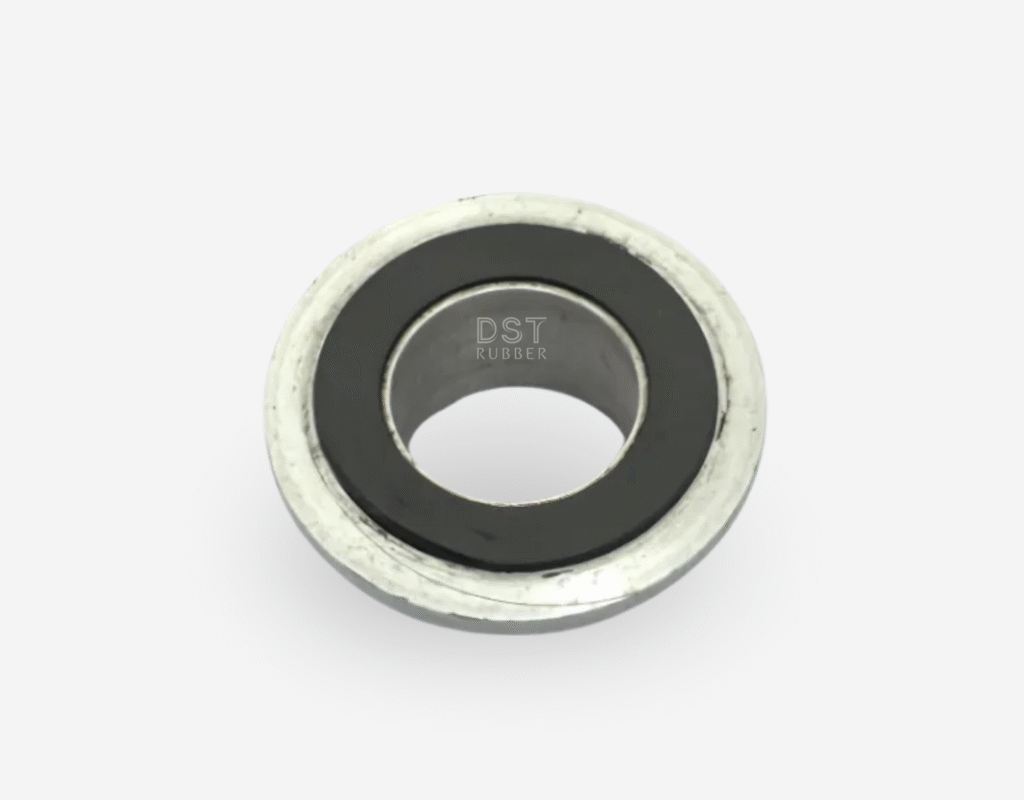
Metal-reinforced diaphragms serve a different purpose — they integrate structural rigidity and dimensional stability, making them ideal for precision instrumentation and hydraulic systems where the diaphragm must interface directly with rigid housings.
The fabric vs. metal reinforcement decision depends on whether your application needs flexibility under load or structural integration with the surrounding assembly. Most manufacturers only offer one or the other. A manufacturer with both — and the engineering knowledge to advise between them — gives you a much better outcome.
6. Their Quality Process Should Catch Problems Before You Do
You should never be the first person to find a defect in your diaphragm. By the time it reaches you, it should have passed dimensional checks, hardness verification, pressure testing, and application-specific validation.
The difference between manufacturers who achieve this consistently and those who don’t comes down to one thing: where quality control happens. End-of-line inspection catches some problems. But in-process checks — at mixing, at moulding, at curing, at post-mould — catch problems before they’re baked into hundreds of parts.
DS Rubber’s manufacturing process includes quality gates at every stage, backed by an in-house laboratory with testing equipment for hardness, tensile strength, chemical resistance, pressure, and dimensional accuracy. Our customer-end rejection rate is zero — not as a marketing claim, but as a measured outcome we track and report.
When you’re evaluating a supplier, ask them specifically: what does your in-process quality control look like? What tests does every diaphragm go through before dispatch? What happens when a batch fails an in-process check? The specificity of their answers tells you how real the process is.
7. They Should Be Able to Handle What You Don't Have Drawings For
Most buyers come to a manufacturer with one of three things: a complete drawing, a sample to reverse-engineer, or a rough specification with open questions. The best manufacturers can start from any of these — and add engineering value to all three.
If you have drawings, a capable manufacturer will review them for manufacturability and flag anything that might cause production issues before tooling is cut. If you have a sample, they should be able to measure, analyse the compound, and replicate (or improve) it. If you have a concept, they should be able to translate it into a design recommendation with material selection included.
This kind of engineering assistance is particularly valuable in new product development or when you’re bringing a previously imported component into domestic production. DS Rubber has helped customers reverse-engineer and indigenise rubber components — including complex automotive parts — from physical samples with no original drawings available.
The material characteristics work that precedes production is where a manufacturer either adds value or passes cost back to you in the form of failed samples and wasted development cycles.
8. Delivery Reliability Is a Quality Issue, Not a Logistics Issue
Late deliveries from a rubber component supplier ripple through your production schedule in ways that are completely disproportionate to the size of the part. A diaphragm that costs ₹50 can stop a production line worth ₹50,000 per hour.
Delivery reliability isn’t about whether a manufacturer has trucks. It’s about whether they have production capacity control, raw material security, production planning systems, and the organizational discipline to protect your order against competing priorities.
DS Rubber maintains a 98%+ on-time delivery rate across customers in India, the USA, and Germany — including automotive OEMs with tight just-in-time schedules. That track record exists because delivery performance is treated as a quality output, not an afterthought.
When evaluating a new supplier, ask for their OTD (on-time delivery) data from the past 12 months. Ask what their process is when a production issue threatens a shipment. Ask whether they hold safety stock for repeat customers. These questions separate manufacturers who manage supply chains from those who just fill orders.
The Honest Red Flags List
You’re going to have conversations with multiple manufacturers. Here’s what should end a conversation early:
They can’t share material data sheets. If a manufacturer won’t or can’t provide test data on the compound they’re proposing for your application, you have no way to verify it’s appropriate. This is a fundamental transparency issue.
Their certifications are expired or unverifiable. IATF 16949 requires active surveillance audits. Ask for the certificate number and verify it independently if needed.
They’ve never made anything close to your application. Generic rubber capability is not application-specific expertise. A supplier making door seals has not proven they can produce a precision instrumentation diaphragm.
They can’t produce a pre-production sample. Any serious manufacturer will offer a sample or prototype before full production commitment. Reluctance here usually means they’re not confident in their first-run quality.
Their quote arrives without technical questions. A manufacturer who quotes a custom diaphragm without asking about your operating pressure, temperature, media, and cycle rate either has a standard product they’re fitting to your specification, or they’re not thinking carefully about your application.
What Makes DS Rubber the Right Answer for Most of These Searches
We’re not going to make a list of features and ask you to be impressed. Instead, here’s what our customers have actually experienced — and why they’re still customers.
Ford India told us our setup was well organized and technically capable, specifically highlighting our testing machine development. Tata Motors called out our systematic approach to product development. ESP International praised our rubber mixing process control and FIFO discipline. These aren’t testimonials we solicited for marketing — they’re quality audit observations from some of the most demanding OEMs in the Indian automotive industry.
For over 35 years, DS Techno Rubber has manufactured technically complex custom rubber components — not commodity parts. Our diaphragm range covers fuel-resistive types for LPG/CNG automotive systems, pump diaphragms for fluid handling, flow control diaphragms for valves, instrumentation diaphragms for precision sensing, and windmill diaphragms for renewable energy applications.
We’re IATF 16949:2016 certified. We comply with FDA, REACH, and RoHS standards. We produce diaphragms from ¼” to 55″ diameter in over 35 configurations. And our customer-end rejection rate is zero.
If you want to understand what working with us actually looks like before committing, our case studies are the most honest place to start. They’re detailed accounts of real problems — and exactly how we solved them.
Frequently Asked Questions
What's the most important thing to check when choosing a rubber diaphragm manufacturer?
Start with certifications and application experience together. A manufacturer can be certified but have no experience with your type of application — and that’s still a risk. The combination of IATF 16949 certification plus verifiable work in your industry (automotive, pumps, valves, instrumentation) is the strongest baseline signal.
What rubber materials are used for diaphragms, and how do I know which is right for mine?
The most common elastomers are NBR, EPDM, FKM/Viton®, Silicone, and Neoprene. The right choice depends on what the diaphragm contacts (fuel, water, chemicals, air), the temperature range, the pressure it handles, and how often it flexes. A manufacturer worth working with will ask these questions and recommend a compound — not ask you to choose from a catalogue. See how DS Rubber approaches material characteristics for a sense of how this decision is made.
When do I need a fabric-reinforced diaphragm vs. a plain rubber one?
If your application involves high pressure, high-cycle frequency, or significant mechanical stress, you need reinforcement. Plain rubber diaphragms are appropriate for low-pressure sealing or light-duty applications. Fabric reinforcement dramatically extends fatigue life and burst pressure resistance. Metal reinforcement adds structural rigidity for precision assemblies. The reinforcement selection process should be guided by your application parameters, not guessed at.
Can a manufacturer produce a diaphragm from a physical sample with no drawings?
Yes — if they have the right capabilities. DS Rubber has done this for multiple customers, including full reverse-engineering and indigenisation of automotive rubber components from samples with no original drawings. The process involves compound analysis, dimensional measurement, and design translation before production begins.
What lead times should I expect for custom rubber diaphragms?
Standard configurations typically take 2–4 weeks. Custom designs requiring new tooling or compound development are usually 4–8 weeks including sample approval. If a manufacturer quotes you a custom diaphragm with a one-week lead time and no sample process, treat that as a red flag.
How do I know if a manufacturer's quality process is real or just on paper?
Ask them to describe their in-process quality control — not just what happens at end-of-line inspection. Ask what percentage of their parts fail internal checks before reaching the customer, and what the process is when that happens. Ask to see a recent customer complaint report (not to see problems, but to see how they handle them). A manufacturer with genuine process control will answer these questions without hesitation.
Does DS Rubber supply to international customers?
Yes. DS Rubber currently exports to customers in the USA and Germany and is equipped to handle international shipping, export documentation, and compliance requirements as standard.
What's the right way to start the conversation with a potential diaphragm manufacturer?
Come prepared with your operating conditions: the media the diaphragm contacts, the pressure range, the temperature range, the expected cycle frequency, and any dimensional constraints. The more specific you can be, the faster the manufacturer can tell you whether they’re the right fit — and give you a meaningful technical response rather than a generic quote.
Ready to Have the Right Conversation?
If this guide has helped you think through your requirements clearly, the next step is straightforward. Share your specification, sample, or application details with our engineering team — and we’ll respond with a technical recommendation, not just a price.