Summary
ISO 9001 certifies that a manufacturer runs a documented quality management system. IATF 16949 builds on ISO 9001 and adds automotive requirements, including defect prevention, APQP, PPAP, FMEA, SPC, measurement system analysis, supplier management, and customer-specific requirements. Neither certification guarantees that a specific part is defect-free. Both prove the process exists and an accredited auditor checked it. Buyers should verify the certificate scope, the certifying body, the site address, and the expiry date.
Every rubber supplier shortlist includes the same two logos: ISO 9001 and IATF 16949. Buyers see them so often that they stop asking what the logos mean. That is a mistake. A certificate does not promise that a specific diaphragm will survive your application. It does prove that an accredited auditor checked how the supplier controls materials, processes, measurement, and change. For procurement managers and quality engineers, understanding that difference decides whether a certificate lowers your risk or just decorates the vendor file.
What ISO 9001 Certification Means for a Rubber Manufacturer
ISO 9001 sets requirements for a quality management system that applies to any industry. A rubber molder certified to ISO 9001 has documented its processes, assigned responsibilities, set quality objectives, controls its records, handles nonconforming product, and runs internal audits and management reviews. An accredited certification body audits those systems and returns every year for surveillance. The certificate tells you the supplier runs a managed, repeatable system. It does not tell you the system targets automotive failure modes.
What IATF 16949 Adds on Top
IATF 16949 builds on the ISO 9001 framework and adds requirements written by automotive manufacturers. It focuses on defect prevention and on reducing variation and waste across the supply chain. A certified site works with the automotive core tools: APQP for planning new products, PPAP for proving a process can make the part to specification, FMEA for anticipating failure modes, MSA for confirming gauges measure reliably, and SPC for monitoring process stability. It also layers in customer-specific requirements from individual automakers and demands stronger supplier control and change management.
ISO 9001 vs IATF 16949 at a Glance
Area | ISO 9001 | IATF 16949 |
|---|---|---|
Scope | Any industry, any product | Automotive production and service parts |
Core focus | Documented quality management and continual improvement | Defect prevention, variation reduction, and waste reduction in the supply chain |
Core tools | Not mandated by name | APQP, PPAP, FMEA, MSA, and SPC expected as part of the system |
Customer requirements | General customer focus | Customer-specific requirements from each OEM layered in |
Supplier control | Control of external providers | Stricter supplier development, monitoring, and second-party audits |
Traceability and change control | Required where applicable | Defined, with tighter product safety and change notification expectations |
What These Certifications Do Not Guarantee
- They do not guarantee a specific part is defect-free. They show the process exists and an auditor assessed it at a point in time.
- They do not prove a compound suits your fluid, temperature, and pressure. You still need material and application data.
- They do not cover every site. A certificate lists the locations and activities in scope, and your part may run elsewhere.
- They do not replace your own incoming inspection, first-article review, or supplier audit.
Treat the certificate as the entry ticket, not the finish line. It narrows the field and raises the floor on process discipline, then your part-level evidence does the rest.
What a Certified System Should Look Like on a Rubber Floor
Certification becomes real when you can see it inside the molding process. Ask the supplier to show you how the system works at each step of making a diaphragm, seal, or molded component.
Rubber Process Step | What the system should control | Evidence to ask for |
|---|---|---|
Compound mixing | Raw material lot control, batch recipes, rheometer or cure checks per batch | Batch records and cure curve data |
Molding and cure | Press temperature, time, and pressure windows; mold maintenance | Control plan and process parameter logs |
Dimensional control | Critical thickness and bead dimensions on diaphragms and seals | SPC charts and capability data on critical features |
Material testing | Hardness, tensile, compression set, and fluid resistance against spec | Test reports tied to production lots |
Change management | Notice before any compound, tool, or site change | Written change procedure and PPAP resubmission rules |
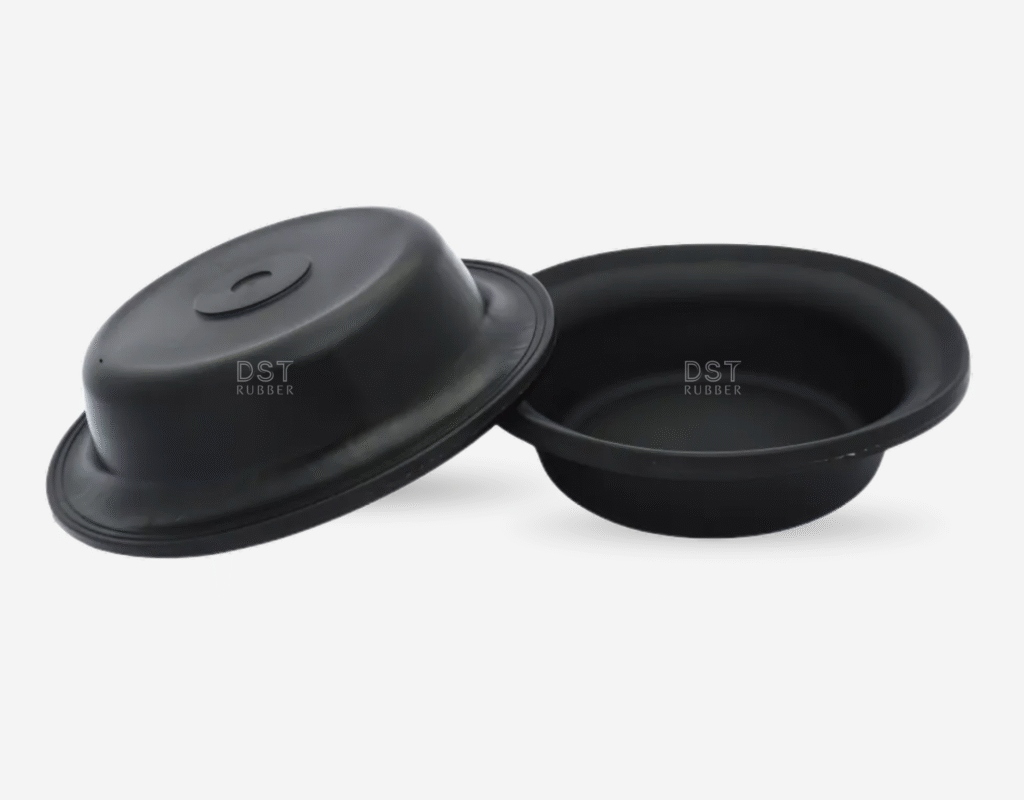
Diaphragms make this concrete. A fuel pump or brake chamber diaphragm fails through thickness variation, a compound that swells, or a bead that takes a set. A certified system should catch each of those through controlled inputs, monitored processes, and recorded results. If you source custom rubber diaphragms or safety-related parts such as air brake chamber diaphragms, the evidence behind the certificate matters as much as the certificate itself.
How to Verify a Certificate in Four Checks
- Entity and site: confirm the legal name and the exact site address that will mold your part.
- Scope: confirm the scope statement covers the products and processes you buy, such as molding of rubber components for automotive applications.
- Certifying body: confirm an IATF-recognized certification body issued the certificate, and look up the number in the IATF database where available.
- Validity: confirm the expiry date and ask about the date of the last surveillance audit and any open major nonconformities.
Then go one step further and request the supporting evidence for your part: the control plan, a recent SPC summary on critical dimensions, material certificates, and the PPAP package. A supplier who shares these readily usually runs a healthy system.
Red Flags in Certification Claims
- A logo with no certificate, no number, and no certifying body named.
- A certificate that covers a sales office or head office but not the molding site.
- A scope that excludes the process you buy, such as compounding or molding.
- Reluctance to share PPAP, control plans, or audit status on request.
How DS Rubber Approaches Quality and Certification
DS Rubber publishes its credentials on its certifications page so buyers can check scope and validity directly. To see how the team, plants, and engineering approach fit together, read more about DS Rubber and its custom rubber manufacturing experience. If your program needs molded parts beyond diaphragms, the custom rubber products program follows the same quality discipline.
Request Our Quality Documentation
Qualifying a new rubber supplier? Review our certifications, then contact our engineering team for control plans, PPAP support, and material test data on your part. You can also request a custom quote and ask us to walk your quality engineers through the process.
Frequently Asked Questions
ISO 9001 sets general quality management requirements for any industry. IATF 16949 includes ISO 9001 and adds automotive-specific requirements: defect prevention, core tools such as APQP, PPAP, FMEA, MSA, and SPC, stricter supplier control, and customer-specific requirements from automakers. A rubber molder with IATF 16949 shows it can run an automotive-grade process, not only a documented one.
No. The certificate proves the manufacturer runs a quality system that an accredited auditor assessed. It does not promise that any given part will pass your application. You still need part-level test data, first-article inspection, and application validation.
Check four items on the certificate: the legal entity name, the site address that molds your part, the scope of certification, and the expiry date. Confirm the issuing certification body is IATF-recognized, and look up the certificate number in the IATF database where available. If the certificate covers a head office but not the molding site, treat it as a gap.
IATF 16949 incorporates ISO 9001 requirements, so an IATF-certified site does not need a separate ISO 9001 certificate to meet automotive customers. Many suppliers still hold both, or hold ISO 9001 for non-automotive lines. Ask which certificate covers the line that will make your part.
Yes, some do, especially for industrial or aftermarket work. The difference is evidence. Without IATF 16949, you carry more of the verification burden through audits, sample inspections, and test reviews. For safety-related automotive parts such as brake or fuel diaphragms, most OEM and Tier 1 programs require it.
Talk to Us About Your Volume
If your program needs a low-volume run, a pilot batch, or a bridge-tooling order, tell us your part, compound requirement, and target quantity and request a custom quote. You can also contact our engineering team first to talk through tooling options that could bring your minimum order down before you commit to a number.
Request a Quote