

Summary
Minimum order quantity on custom rubber parts is driven mainly by tooling amortization, mixing batch size, and cure-press scheduling, not the part itself. Buyers can lower MOQ by using compression tooling instead of injection, sharing cavities across similar parts, accepting standard compounds over custom-matched ones, or paying a small-batch surcharge instead of committing to volume. A genuine low-MOQ manufacturer will quote tooling and piece price separately and explain its minimum mixing batch size upfront.
A procurement manager pulls three quotes for a custom rubber part and finds the same problem on every one: a minimum order quantity that far exceeds what the program actually needs this year. Pilot programs, aftermarket runs, low-volume vehicle platforms, and early-stage prototypes rarely need 10,000 pieces, yet many rubber molders price and structure their operations as if every order does. This guide explains what actually drives MOQ on custom rubber parts, which levers a buyer can pull to bring it down, and how to tell a real low-MOQ manufacturer from one that will just pad the order to hit their own minimum.
Why Rubber Parts Carry a Minimum Order Quantity in the First Place
MOQ on a molded rubber part rarely comes from the molder being difficult. It comes from three specific costs that do not scale down cleanly with part count: the tooling investment that has to be amortized across the order, the minimum batch weight a compound mixer will run economically, and the setup and changeover time a molding press loses every time it switches jobs. A 300-piece order and a 30,000-piece order can carry nearly the same fixed cost, which is why unit price rises sharply as volume drops unless a supplier has specifically built a process to handle small batches.
What Drives MOQ and How to Bring It Down
The table below breaks out the main cost drivers behind a typical MOQ and the practical lever a buyer has to reduce each one.
Cost Driver | Why It Raises MOQ | How to Reduce It |
|---|---|---|
Tooling amortization | Mold cost is spread across the order. A smaller order carries more tooling cost per piece. | Share cavities with a similar part, or accept a longer tooling payback across repeat orders. |
Mixing batch size | Rubber compounds mix in batches with a minimum economical weight, regardless of part count. | Use a standard, already-mixed compound close to your spec instead of a custom match. |
Press changeover time | Setting up a press for one job costs time whether it runs 200 parts or 20,000. | Ask about open press windows or slower delivery slotted between larger runs. |
Compound customization | A fully custom-matched compound (color, hardness, additive package) needs its own batch. | Choose from the supplier’s existing compound library where performance allows. |
Inspection and documentation | Test reports and PPAP-level documentation take similar effort regardless of batch size. | Confirm what documentation level is included at low volume versus full production volume. |
When Low-MOQ Sourcing Makes Sense
- Prototype and pilot builds where the design may still change before full production tooling is justified.
- Aftermarket and service-part programs supporting older platforms with declining but ongoing demand.
- Low-volume or niche vehicle platforms, including specialty and commercial vehicle variants, that never reach mass-production volumes.
- New supplier qualification runs, where a buyer wants a small validation batch before committing to a full-volume purchase order.
- Bridge tooling situations, where a buyer needs parts fast from a lower-cost tool while a production-grade mold is still being built.
Questions to Ask a Low-MOQ Rubber Parts Manufacturer
- What is your minimum mixing batch size for the compound my part requires, and how does that map to piece count?
- Do you quote tooling and piece price separately, so I can see exactly what a smaller order costs me?
- Can you run my part in a shared or multi-cavity tool to reduce tooling cost per piece?
- What documentation and testing do I get at low volume versus full production volume, and is anything dropped to hit a lower price?
- What is your lead time for a small batch compared to a full production run, and does a small order get deprioritized on the press schedule?
A supplier who answers these clearly, with numbers rather than reassurance, is far more likely to deliver a genuine low-MOQ program than one who simply says yes to any volume you name.
The Quality Question: Does Low MOQ Mean Lower Standards?
It should not, and that is the point worth pressing hardest in supplier qualification. A legitimate small-batch program still runs the same compound certification, cure control, and inspection as a full production run, just at a smaller scale and a higher unit cost. The risk in low-MOQ sourcing shows up when a supplier quietly drops test steps, skips documentation, or substitutes an uncertified compound to hit a price point. Ask specifically what stays the same and what changes between your low-volume order and a hypothetical full-volume order from the same supplier, and treat a vague answer as a warning sign.
How DS Rubber Supports Low-Volume and Pilot Programs
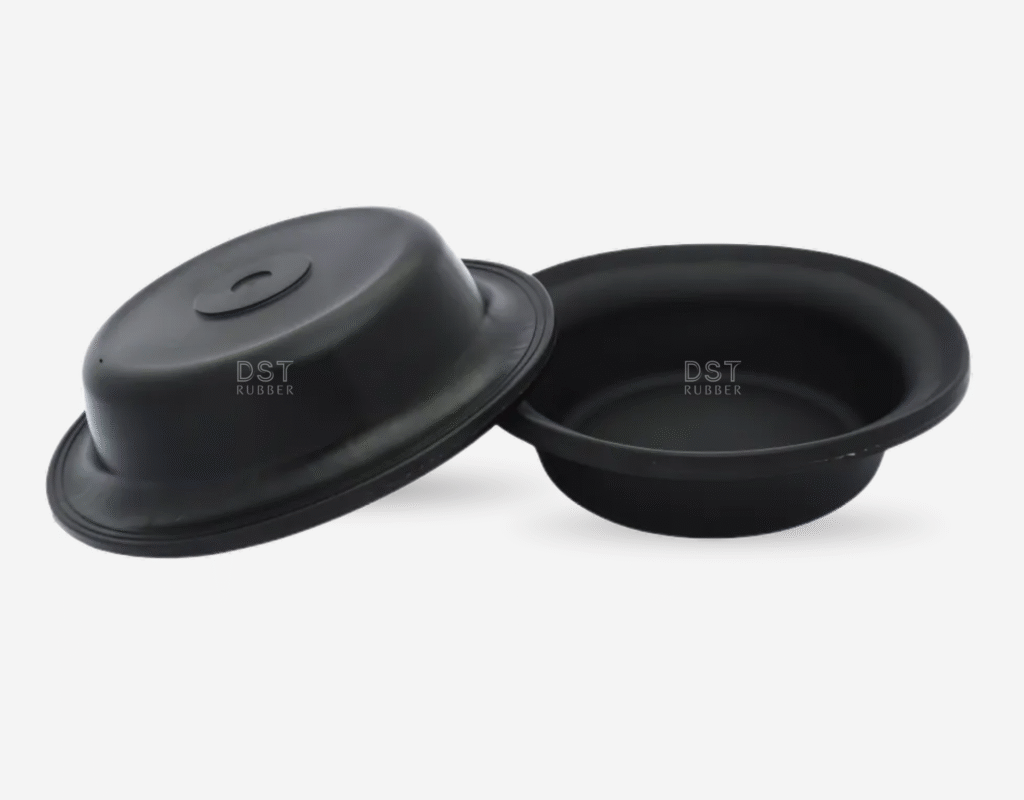
DS Rubber structures its custom rubber products program to work with buyers who need real volume flexibility, from early prototype batches through full production ramp, without cutting the material testing or documentation a program depends on later. That flexibility extends across the company’s custom rubber diaphragms line and other molded components, built on the same custom rubber manufacturing processes used for high-volume OEM programs. If your project needs a smaller first order than most molders will quote, that is a conversation worth having directly rather than assuming the door is closed.
Frequently Asked Questions
MOQ varies by process and part size, but many custom molders set minimums between 500 and 5,000 pieces per compound and cavity to justify a mixing batch and a press changeover. Low-MOQ manufacturers structure pricing to accept orders in the low hundreds, usually with a piece-price premium that reflects the shorter run.
Three costs drive it: tooling amortization, the minimum batch size a mixer can economically produce for a given compound, and the setup and changeover time on a molding press. A supplier running a large batch across many customers’ parts spreads that cost; a dedicated small run carries it alone, which is why unit price rises as volume falls.
Not usually. Even prototype and bridge-tooling runs have a practical floor, often in the tens to low hundreds of pieces, because a mixer will not run a batch smaller than its minimum charge weight. What changes with a good low-MOQ supplier is how close to that floor they can quote profitably.
Not if the supplier still runs the same material certification, cure process, and inspection on the small batch. Quality risk in low-MOQ sourcing comes from suppliers who skip documentation to hit a price, not from batch size itself. Ask for the same test and traceability data on a 300-piece order that you would expect on a 30,000-piece order.
Ask whether the supplier can mold your part in a multi-cavity tool shared with a similar geometry, whether a standard compound close to your spec exists instead of a custom-matched one, and whether compression tooling is an option instead of injection. Any of these can bring the minimum down without touching your design.
Talk to Us About Your Volume
If your program needs a low-volume run, a pilot batch, or a bridge-tooling order, tell us your part, compound requirement, and target quantity and request a custom quote. You can also contact our engineering team first to talk through tooling options that could bring your minimum order down before you commit to a number.
Request a Quote