

Summary
To choose a custom rubber diaphragm manufacturer, verify IATF 16949 or ISO 9001 certification, in-house compound and tooling engineering, documented test data (ASTM D412, D395, D471, burst and fatigue), PPAP capability, realistic prototype and production lead times, and lot-level traceability. Send every shortlisted supplier the same drawing, material callout, annual volume, and test requirements so you can compare quotes on equal terms.
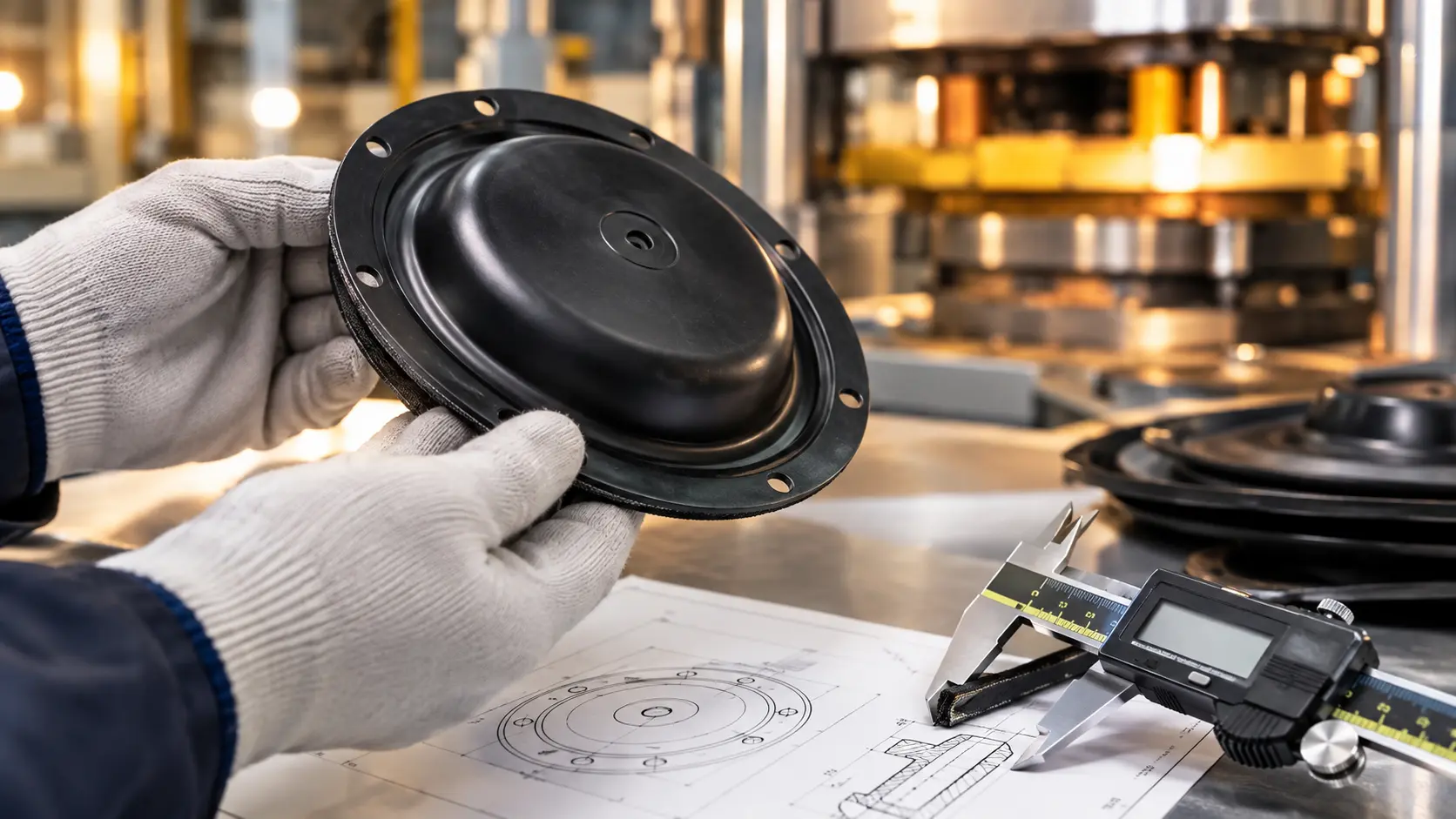
You have a drawing, a target launch date, and three suppliers that all claim they can mold your diaphragm. The quotes look close. The risk sits underneath them. A diaphragm that arrives 0.15 mm out of thickness tolerance, or in a compound that swells in your fluid, does not show up until the part is in an assembly, and by then you own the cost. This checklist gives procurement managers and R&D engineers a structured way to compare custom rubber diaphragm manufacturers before the first purchase order.
Why Supplier Selection Needs a Formal Checklist
Diaphragms look like simple molded discs, so buyers sometimes source them like commodity gaskets. They behave differently. A diaphragm flexes thousands of times, seals against pressure or vacuum, and often carries fabric reinforcement that controls burst strength. Small variations in compound, cure, and thickness change fatigue life and sealing force. A checklist forces every supplier through the same questions, which turns a sales conversation into a data comparison.
The 10-Point Supplier Checklist
Use this table during supplier screening. Score each supplier against each row, and treat any red flag as a question that needs a written answer before you request a sample.
Criterion | What to verify | Red flag |
|---|---|---|
Quality system | Current IATF 16949 or ISO 9001 certificate covering the molding site | Certificate covers a different facility or has expired |
Compound engineering | In-house formulation or a vetted compound library with ASTM D2000 callouts | Cannot explain why a compound suits your fluid and temperature |
Tooling and molding | Compression, transfer, or injection capability; fabric-reinforced diaphragm experience | Outsources tooling with no visibility into mold ownership |
Test data | ASTM D412, D395, D471, D573 results plus burst and flex-fatigue data | Offers only a generic material datasheet |
PPAP and documentation | Can deliver PPAP at your required level, control plan, and material certs | Treats PPAP as an add-on after PO |
Lead time | Separate tooling, sample, and production lead times in writing | Single vague delivery date |
Capacity and MOQ | Stated MOQ, monthly capacity, and safety-stock options | No answer on surge volume |
Traceability | Lot-level raw material and cure-batch traceability | Traceability limited to invoice date |
Application experience | Prior work in your system (fuel, brake, HVAC, EGR, turbo) | No reference parts in similar duty cycles |
Commercial terms | Transparent tooling cost, price breaks, and rejection handling | Unclear tooling ownership or change-order fees |
Checklist Details: What Good Answers Look Like
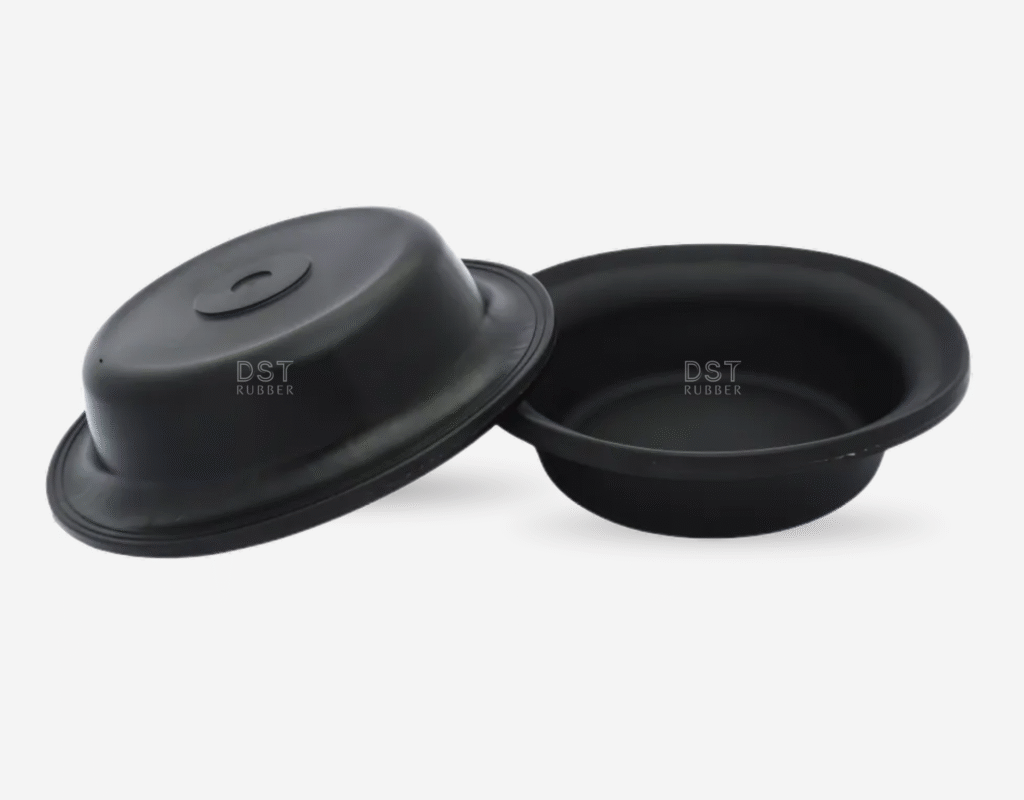
A standard, or homogeneous, diaphragm is compression- or transfer-molded from a single rubber compound, such as NBR, EPDM, silicone, or FKM, with no internal reinforcing layer. The entire load-bearing capacity comes from the elastomer itself.
This construction is simpler to manufacture and generally lower cost, and it works well where pressures are modest and cycle counts are low. Because the rubber alone must resist stretch, plain diaphragms elongate more under pressure and are more prone to creep and fatigue over time.
1. Quality System and Certifications
Ask for the certificate itself, not a logo on a website. IATF 16949 signals a quality system built for automotive production, including process control, corrective action, and traceability. Check the certificate scope and confirm that the site molding your part appears on it. If your program is commercial vehicle braking, this step carries extra weight, so review how the supplier controls its air brake chamber diaphragms process as a reference point for its discipline on safety-related parts.
2. Compound and Material Engineering
A capable supplier explains why a compound fits your application. For fuel exposure, that conversation covers acrylonitrile content in NBR or a move to fluoroelastomer for ethanol blends. For outdoor ozone exposure, it covers EPDM. Ask the supplier to write your material requirement as an ASTM D2000 or SAE J200 line callout. If a supplier cannot do that, expect problems when your quality team audits incoming lots. Buyers sourcing fuel system parts should look at how a supplier approaches fuel resistive diaphragms and swell control under ASTM D471 immersion testing.
3. Tooling and Molding Capability
Match the process to the part. Compression molding suits many low-to-mid volume diaphragms. Transfer and injection molding suit tighter tolerances and higher volumes. Fabric-reinforced designs need a supplier that knows how to laminate the scrim, control cure, and hold thickness across the diaphragm face. Ask who owns the mold, where it lives, and what happens to it if you move production.
4. Test Data and Documentation
Request real results on parts similar to yours. Useful data includes tensile and elongation (ASTM D412), compression set (ASTM D395), fluid immersion (ASTM D471), heat aging (ASTM D573), plus burst pressure and flex-fatigue cycle results. A generic compound datasheet tells you what the rubber can do. Part-level test data tells you what your diaphragm will do.
5. PPAP and Change Control
Confirm the supplier delivers PPAP at the level your program needs, typically Level 3 for new automotive parts. Ask how they handle process changes, and require notification before any compound, tooling, or site change. Silent changes cause many field failures that start as quiet supplier decisions.
6. Lead Time, Capacity, and MOQ
Get three numbers in writing: tooling lead time, first-article sample lead time, and production lead time after approval. Then ask about monthly capacity and MOQ. A supplier that quotes a short lead time but has no capacity for a volume ramp will slow your launch.
7. Traceability
Lot-level traceability lets you contain a problem quickly. Ask whether the supplier tracks raw material batches, cure dates, and inspection records against each shipped lot, and how fast they can produce that record after a complaint.
8. Application Experience
Ask for reference parts in similar duty cycles. A supplier that already builds fuel, brake, HVAC, EGR, or turbo diaphragms brings failure-mode knowledge that a general molder lacks. Review the breadth of the supplier’s custom rubber diaphragms range and ask which programs resemble yours.
Red Flags That Should Pause the Shortlist
- The supplier quotes without asking about fluid, temperature, pressure, or duty cycle.
- The supplier offers no part-level test data and points only to a generic datasheet.
- Tooling ownership, change-order fees, or rejection terms stay vague.
- Sample lead time sounds fast but the supplier cannot say who cuts the tool.
- The certificate does not cover the site that will mold your part.
How to Run the RFQ So Quotes Compare Cleanly
Send every shortlisted supplier the same package:
- 2D drawing or 3D model with critical dimensions and tolerances flagged.
- Material callout or named compound, plus fluid, temperature, and pressure exposure.
- First-order and annual volume forecast.
- Required tests, acceptance criteria, and PPAP level.
- Packaging, labeling, and delivery requirements.
Ask suppliers to return pricing, tooling cost, lead times, and test data in the same format. Then score the responses against the checklist above and weigh total cost, including warranty exposure, rather than piece price alone.
Where DS Rubber Fits in Your Shortlist
DS Rubber builds custom molded parts through its custom rubber products program, with diaphragms as a core line. The team works across fuel, brake, HVAC, EGR, and turbocharger applications, and it supports engineers from compound selection through sampling. You can review the full range of reinforced rubber diaphragms, or read about the company’s custom rubber manufacturing capabilities before you send a drawing. Run DS Rubber through the same checklist you use for every other supplier and compare the answers side by side.
Frequently Asked Questions
For automotive and commercial vehicle work, IATF 16949 is the baseline quality system most OEMs and Tier 1 integrators require. ISO 9001 is the minimum for general industrial diaphragms. Ask for the current certificate, the scope statement, and the certifying body, and confirm the molding site you will buy from sits inside that scope.
Send the 2D drawing or 3D model, the material callout (an ASTM D2000 or SAE J200 line callout, or a named compound), fluid and temperature exposure, annual and first-order volume, critical tolerances, required tests, and the PPAP level you expect. Sending the same package to every supplier keeps quotes comparable.
Timelines depend on tooling. A new mold, first-article samples, and inspection data typically take several weeks. A supplier with an existing tool library or a similar past part can move faster. Ask each supplier to state tooling lead time and sample lead time separately.
PPAP, the Production Part Approval Process, is the documented evidence package that proves a supplier’s process can produce your part to specification at production rates. Buyers usually request Level 3, which includes samples plus supporting data such as dimensional results, material certifications, and a control plan.
Rarely. Diaphragms fail through compound choice, thickness variation, and bead sealing, none of which show on a price sheet. Compare quotes alongside test data, tooling ownership terms, scrap and rejection commitments, and lead-time reliability, then calculate total cost including warranty exposure.
Request a Quote for Your Custom Diaphragm
Ready to put suppliers through the checklist? Send your drawing, material requirement, and volume forecast, and request a custom quote from the DS Rubber team.
Request a Quote