

Summary
Standard and fabric-reinforced diaphragms differ mainly in how they handle pressure, repeated flexing, and mechanical stress. Standard diaphragms use a single elastomer layer and are generally suited to low-pressure, low-cycle applications, while fabric-reinforced diaphragms use an internal fabric ply to improve burst pressure, tear resistance, dimensional stability, and fatigue life. The right diaphragm construction depends on pressure, cycle count, temperature, media compatibility, and application requirements.
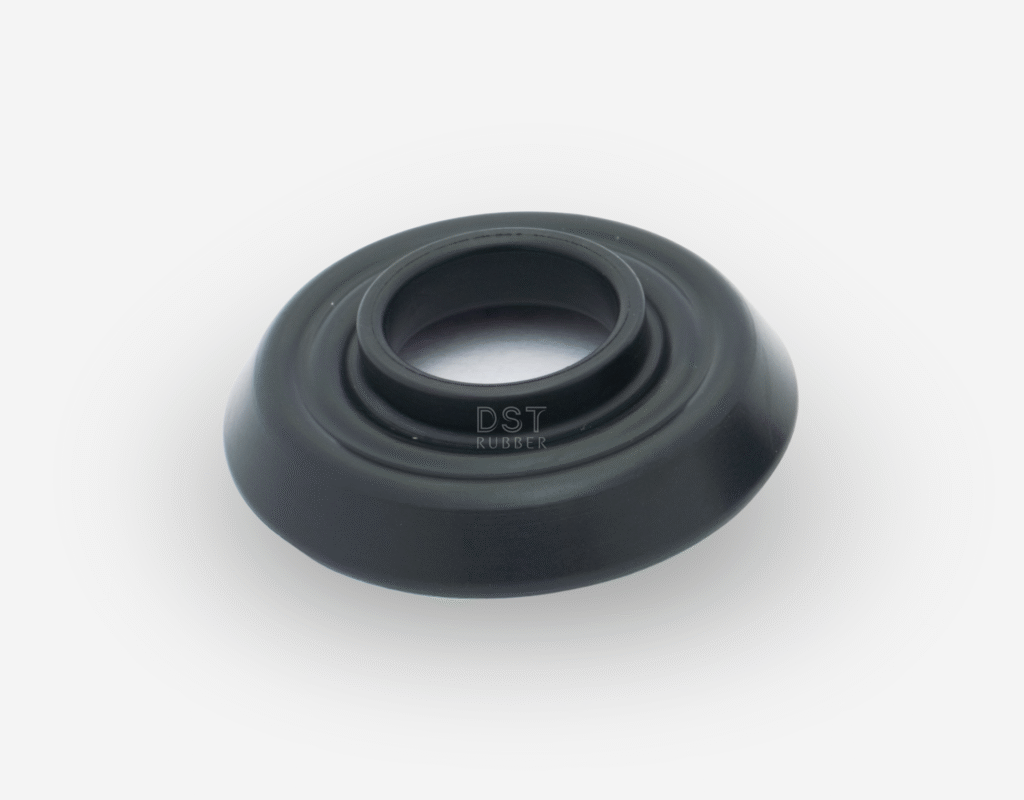
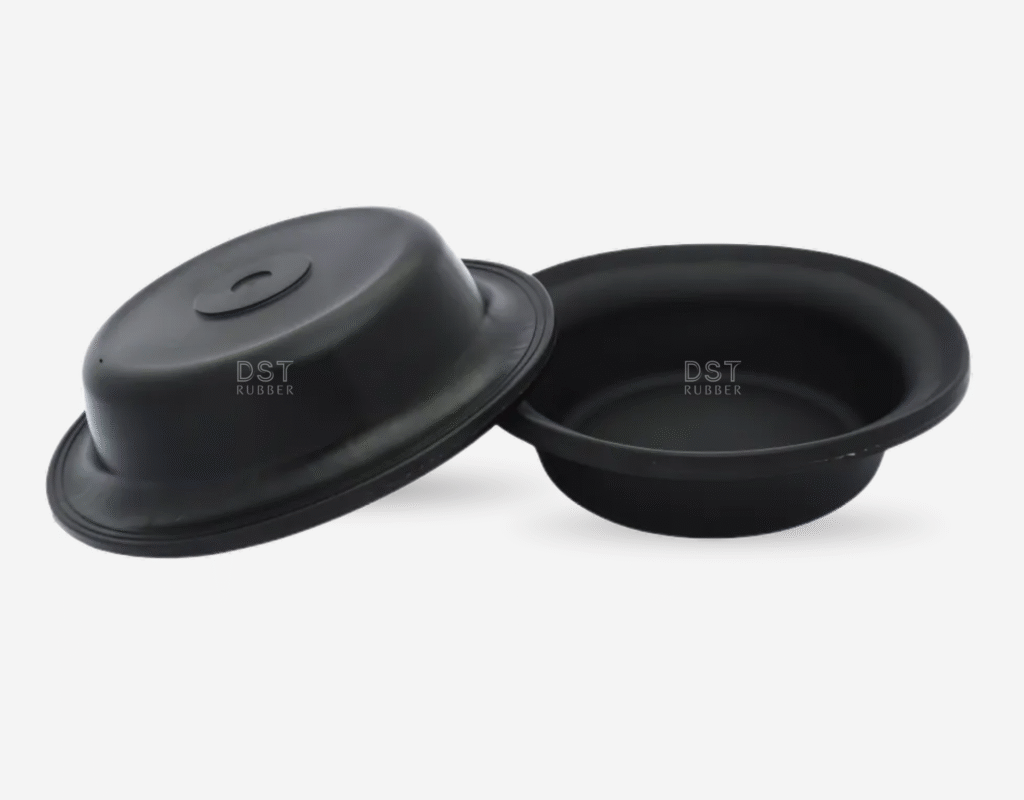
A rubber diaphragm is a thin, flexible elastomeric membrane, usually circular or oval, clamped around its edge and free to flex in the center. It separates two chambers of a pump, valve, or regulator and moves back and forth as pressure changes on either side.
When pressure builds on one face of the diaphragm, the membrane deflects toward the low-pressure side. That deflection pushes fluid or gas through a valve seat, drives a piston or rod, or actuates a pilot mechanism. The diaphragm handles two jobs at once: sealing (keeping the two chambers isolated) and actuating (converting pressure into mechanical movement).
Every time the diaphragm flexes, the rubber at the flex radius stretches and relaxes. Repeated over thousands or millions of cycles, this stretching is what eventually causes fatigue cracking, and it’s the failure mode that reinforcement is designed to delay.
Engineers researching diaphragm materials for valves and actuators or pump applications typically start here, with flex mechanics, before deciding on construction type.
That is why sourcing a diaphragm supplier on unit price alone is a common and costly mistake. Two diaphragms can look identical on a data sheet and perform very differently once installed, depending on the manufacturer’s material engineering, quality control, and testing discipline behind that data sheet. The checklist below is built around the questions that actually predict long-term performance, not just the questions a quote form asks.
Standard Diaphragms vs. Fabric-Reinforced Composite Diaphragms
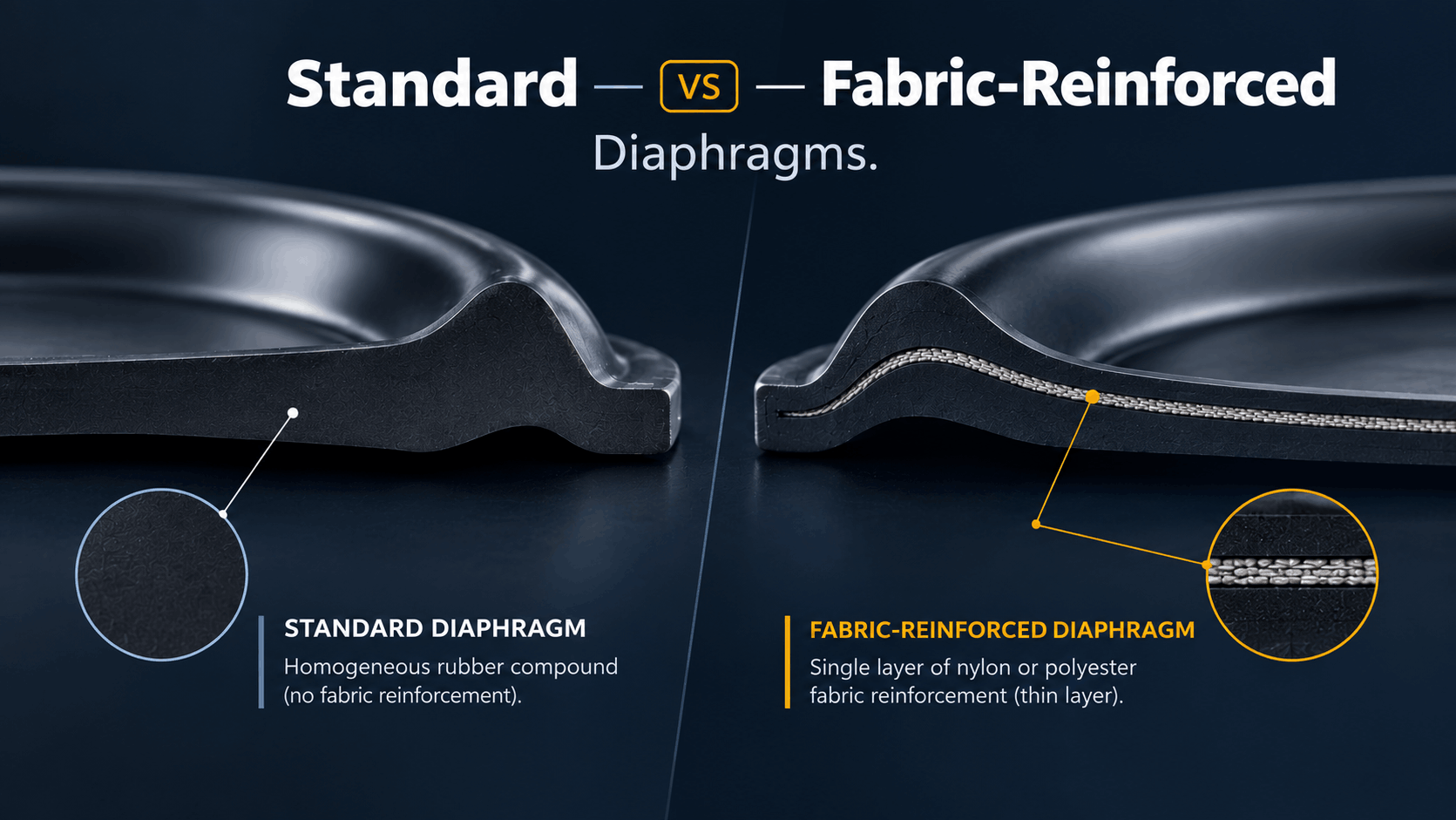
A standard diaphragm is one solid elastomer layer. A fabric-reinforced diaphragm sandwiches a woven fabric ply inside the rubber to control stretch and add strength.
| Feature | Non-Reinforced Rubber Diaphragm | Fabric Reinforced Diaphragm |
| Construction | Pure elastomer construction | Elastomer + reinforcement fabric |
| Pressure Capability | Low to Medium | Medium to High |
| Flexibility | Excellent | Controlled flexibility |
| Typical Applications | Pumps, regulators, valves | Pneumatic systems, fuel systems |
| Key Advantages | High flexibility, low cost | High burst strength, fatigue resistance |
| Burst Strength | Moderate | High |
| Fatigue Life | Good | Excellent |
| Dimensional Stability | Moderate | High |
| Stretching Under Load | Higher | Lower |
How a Plain Elastomeric Diaphragm Is Built
A standard, or homogeneous, diaphragm is compression- or transfer-molded from a single rubber compound, such as NBR, EPDM, silicone, or FKM, with no internal reinforcing layer. The entire load-bearing capacity comes from the elastomer itself.
This construction is simpler to manufacture and generally lower cost, and it works well where pressures are modest and cycle counts are low. Because the rubber alone must resist stretch, plain diaphragms elongate more under pressure and are more prone to creep and fatigue over time.
How a Fabric-Reinforced Diaphragm Is Built
A fabric-reinforced diaphragm embeds one or more plies of woven or knitted fabric, commonly nylon, polyester, or Nomex, inside the rubber matrix, usually positioned at or near the neutral bending axis. The fabric functions like rebar in concrete: the rubber still provides the seal and flexibility, but the fabric carries the tensile load during each flex cycle.
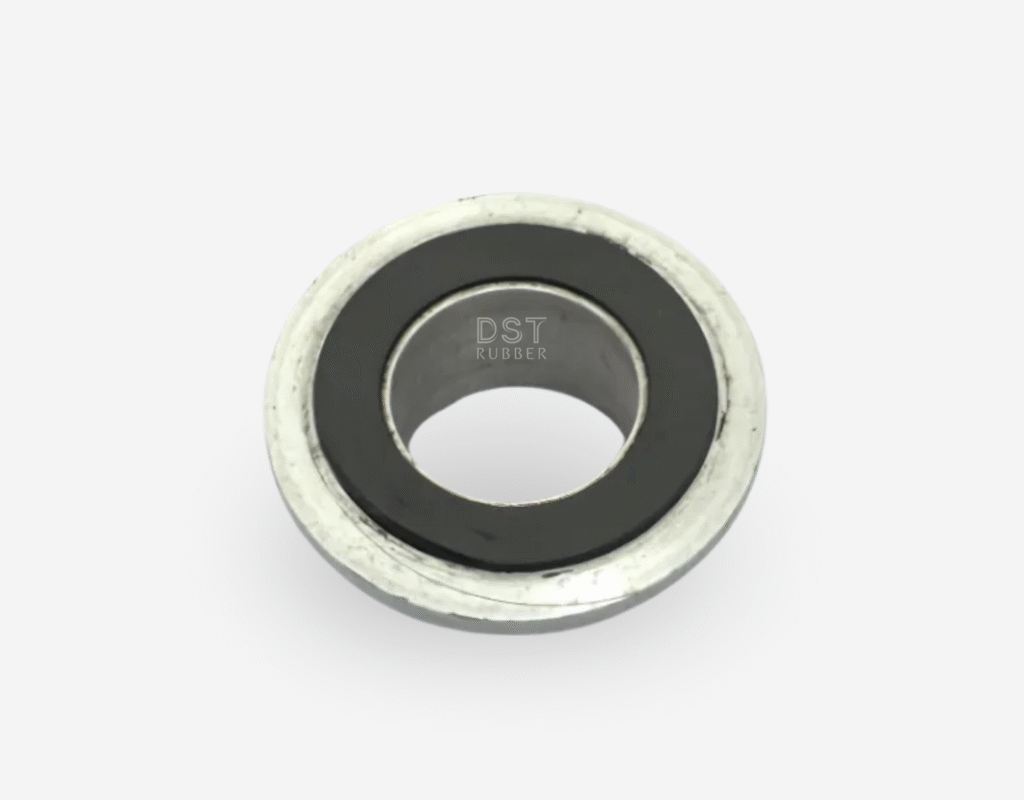
This composite structure lets the diaphragm resist higher burst pressures without ballooning or over-stretching, and it also confines crack propagation if the rubber surface develops micro-tears. DS Rubber’s fabric-reinforced diaphragm line is built around this principle. For applications needing even higher structural rigidity, metal-reinforced diaphragms extend the same logic with a metal insert instead of fabric.
Burst Pressure, Cycle Life, and Tear Resistance Compared
Performance Criterion | Standard (Homogeneous) Diaphragm | Fabric-Reinforced Diaphragm |
Burst Pressure | Lower, limited by elastomer tensile strength alone | Significantly higher, fabric ply shares tensile load |
Cycle Life (Fatigue Resistance) | Shorter, unreinforced diaphragms fail up to 70% faster in high-pressure use | Longer, fabric limits repeated over-stretching that causes fatigue cracking |
Tear Resistance | Moderate, a nick can propagate quickly through the rubber | Higher, fabric weave arrests tear propagation |
Dimensional Stability Under Pressure | Prone to creep and ballooning over time | Stable, fabric constrains elongation |
Manufacturing Cost and Complexity | Lower cost, simpler tooling | Higher cost, added lay-up step |
Best Fit | Low-pressure, low-cycle, cost-sensitive components | High-pressure, high-cycle, safety-critical or heavy-duty applications |
Burst Pressure Ratings
Burst pressure is the point at which a diaphragm ruptures under static or dynamic load. Because a homogeneous diaphragm relies entirely on the elastomer’s own tensile strength, it typically bursts at lower pressures than a comparable fabric-reinforced design of the same thickness and compound. Adding a fabric ply raises the effective burst threshold without a proportional increase in rubber thickness, which also keeps the diaphragm flexible rather than stiff.
Cycle Life and Fatigue Resistance
Cycle life is where the two constructions diverge most. Every flex cycle stretches the material at the fold radius, and over time this repeated strain nucleates micro-cracks that grow into fatigue failure. In high-pressure applications, unreinforced diaphragms fail up to 70% faster than fabric-reinforced variations, because the rubber alone absorbs the full strain on every cycle. A fabric ply redistributes that strain and meaningfully extends service intervals, a factor maintenance managers track closely as mean time between failures on pump and valve fleets.
Tear and Puncture Resistance
Diaphragms are also exposed to point damage: particulate in the fluid stream, sharp valve seats, or assembly nicks. In a plain diaphragm, a small tear can propagate rapidly across the membrane once it starts. A fabric-reinforced diaphragm’s woven layer acts as a physical stop, containing the tear and preventing sudden failure, which is often the difference between a scheduled replacement and an unplanned shutdown.
How Reinforcing Fabrics Change Performance: Nylon vs. Polyester vs. Nomex
Not all reinforcing fabrics behave the same way, and the choice changes the diaphragm’s performance envelope:
- Nylon: high flex-fatigue resistance and good elongation recovery, a strong general-purpose choice for pump and valve diaphragms under continuous cycling.
- Polyester: lower moisture absorption and better dimensional stability than nylon, which keeps burst pressure and stiffness consistent over long-term exposure to humidity or aqueous media.
- Nomex: an aramid fiber with high heat resistance, selected for diaphragms operating near elevated temperatures, such as automotive exhaust-adjacent components or fire-resistant service. See DS Rubber’s fire-resistant diaphragms.
The reinforcing fabric works alongside the base elastomer compound, so material selection should be evaluated together. See DS Rubber’s overview of reinforcement options and rubber physical properties for compound-level compatibility.
Diaphragm Material Selection by Media and Industry
| Elastomer | Typical Media | Typical Industry |
| NBR + Nylon | Oil, fuel, LPG | Automotive |
| EPDM + Polyester | Water, steam, air | Industrial |
| Silicone + Fiberglass | Hot air, food contact | Medical/Food |
| FKM + Aramid | Fuels, solvents | Chemical processing |
| HNBR + Aramid | Hydraulic oils | Automotive OEM |
Which Diaphragm Type Does Your Application Need?
As a working rule for early-stage specification:
- Choose a standard diaphragm for low-pressure, low-cycle, or cost-driven components: small instrumentation diaphragms, short-duty-cycle pilot valves, or applications with generous safety margins.
- Choose a fabric-reinforced diaphragm for high-pressure systems, continuous-duty pumps, safety-critical shutoff valves, or any application where unplanned failure carries downtime or safety cost.
Rubber remains the dominant material choice across industrial sealing. Elastomeric solutions account for roughly 30% of the global industrial seals market, which is why getting the construction type right at the design stage matters for long-term reliability. For application-specific guidance, see DS Rubber’s dedicated pages on pump diaphragms, flow control diaphragms, air brake chamber diaphragms, and fuel-resistive diaphragms.
FAQs
A rubber diaphragm is a flexible elastomeric membrane that flexes under pressure differential to seal and actuate pumps, valves, and regulators.
A standard diaphragm is one homogeneous rubber layer. A fabric-reinforced diaphragm embeds a nylon, polyester, or Nomex ply inside the rubber to raise burst pressure and extend cycle life.
Yes. In high-pressure use, unreinforced diaphragms fail up to 70% faster than fabric-reinforced ones due to mechanical fatigue.
Nylon suits general flex-fatigue duty, polyester offers better dimensional stability, and Nomex is chosen for high-heat environments.
When pressure and cycle counts are low and cost is the primary constraint, such as small instrumentation or short-duty-cycle components.
Find the Right Diaphragm for Your Application
Not sure whether a standard or fabric-reinforced diaphragm is right for your application? Talk to DS Techno Rubber's engineering team for application-specific guidance.
Enquire now