Summary
Choosing a custom rubber diaphragm manufacturer means evaluating material engineering capability, quality certifications such as IATF 16949 or ISO 9001, tooling and prototyping speed, minimum order quantity flexibility, in-house testing (burst pressure, cycle life), and proven experience in your industry before requesting a quote.
Why the Right Manufacturer Choice Matters More Than the Right Price
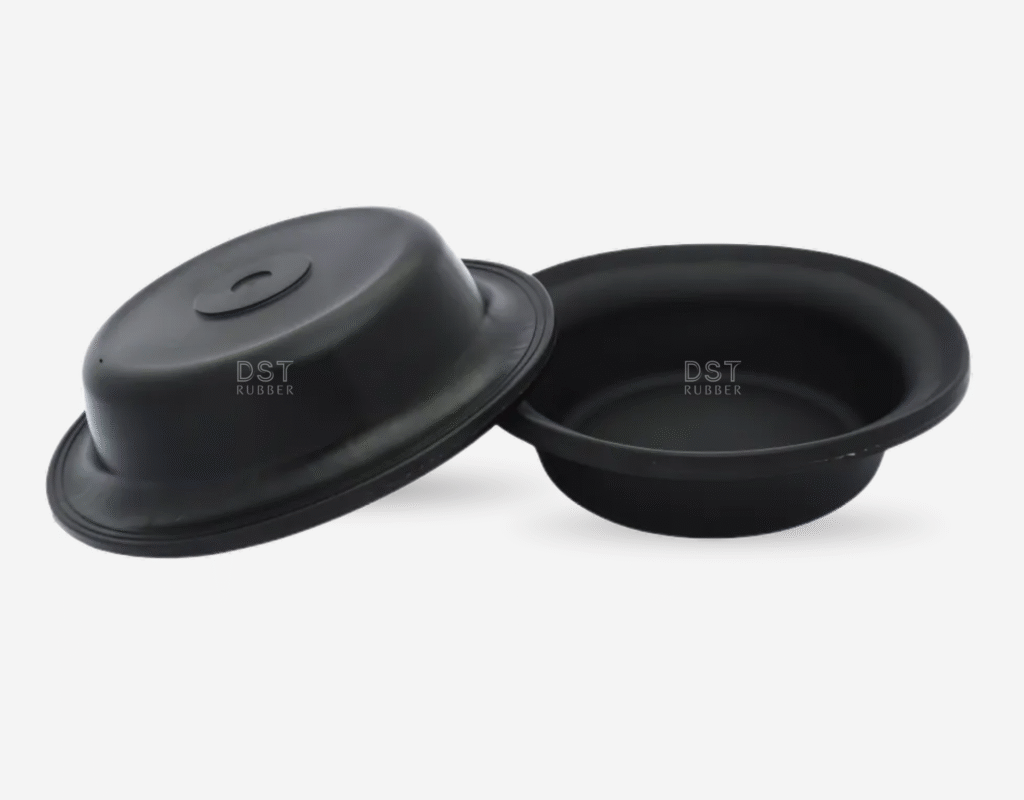
A rubber diaphragm sits inside a pump, valve, or regulator and does two jobs at once: it seals two chambers apart and it flexes thousands or millions of times to actuate the mechanism. When it fails, the failure is rarely a minor inconvenience. It usually means unplanned downtime, a field recall, or a safety incident, depending on the application.
That is why sourcing a diaphragm supplier on unit price alone is a common and costly mistake. Two diaphragms can look identical on a data sheet and perform very differently once installed, depending on the manufacturer’s material engineering, quality control, and testing discipline behind that data sheet. The checklist below is built around the questions that actually predict long-term performance, not just the questions a quote form asks.
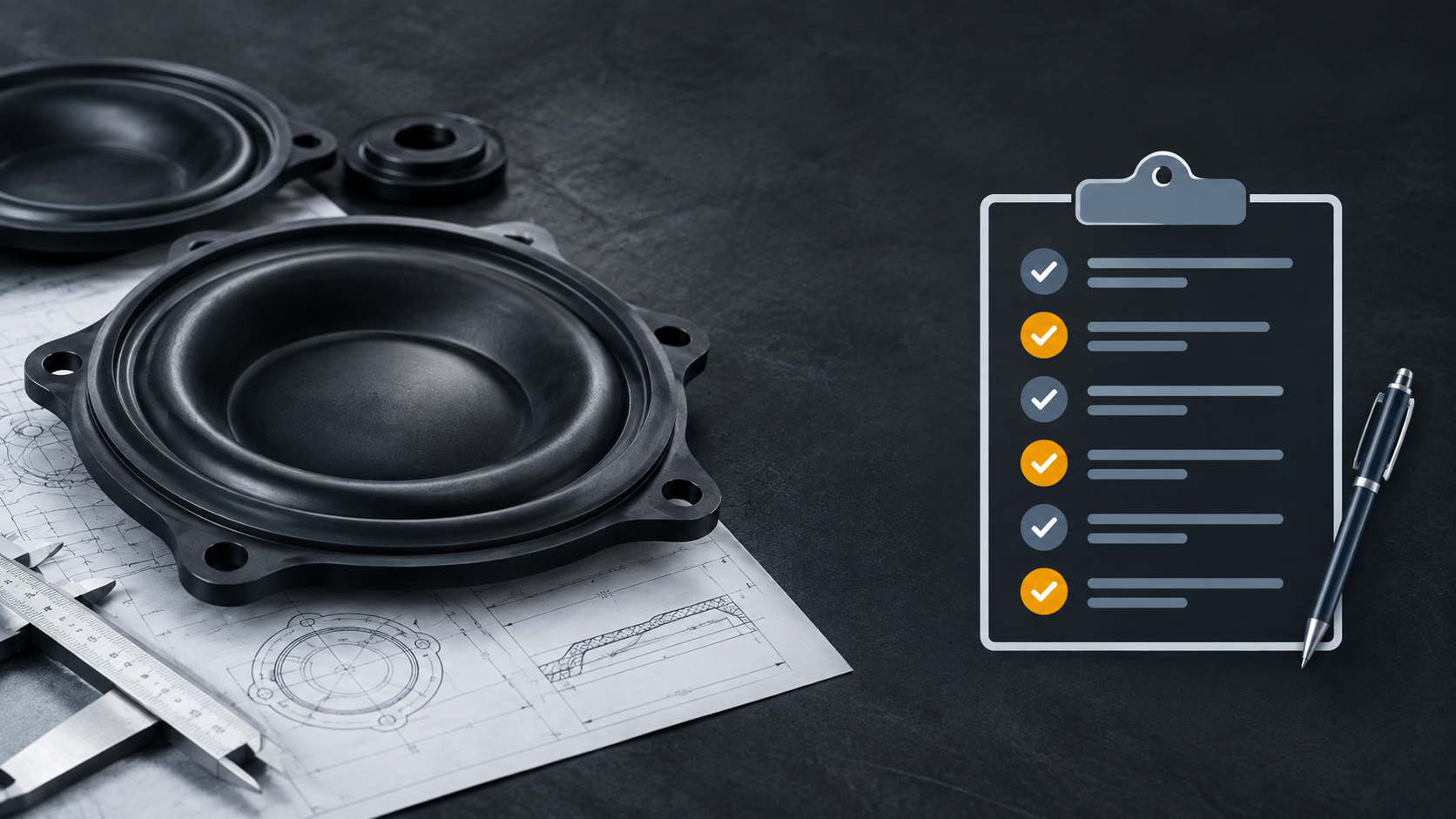
The 9-Point Procurement Checklist
1. Material and Compound Engineering Capability
Start by confirming the manufacturer formulates and tests its own rubber compounds rather than buying pre-mixed stock compounds off the shelf. A supplier with in-house compounding can tune hardness, chemical resistance, and temperature range to your exact application instead of forcing your spec to fit their nearest standard compound. Ask what elastomer families they routinely work with (NBR, EPDM, FKM, silicone) and whether they can share a compound’s full physical property data sheet, not just a summary line.
2. Quality Certifications (IATF 16949, ISO 9001)
IATF 16949 is the automotive-sector quality management certification, and ISO 9001 is the general manufacturing quality standard. Neither certification guarantees a perfect part, but both require a documented, auditable process for traceability, corrective action, and statistical process control. If you are sourcing for an automotive or safety-critical application, IATF 16949 should be a pass or fail requirement, not a nice-to-have.
3. Tooling and Prototyping Turnaround
Custom diaphragms require dedicated tooling, and tooling lead time is often the single biggest variable in your total project timeline. Ask directly how long tool fabrication takes for a diaphragm mold, whether they build tooling in-house or outsource it, and whether they can produce a short-run prototype before committing to full production tooling. A manufacturer who cannot answer this precisely has not done it often.
4. Minimum Order Quantity (MOQ) Flexibility
Minimum order quantity, or MOQ, is the smallest batch size a manufacturer will accept per order. Many manufacturers are built around large-volume automotive or industrial contracts and treat prototype or low-volume orders as an afterthought, which shows up as long lead times and high per-unit pricing. If your program starts small, ask specifically how the manufacturer handles low-MOQ or first-article orders, and whether pricing scales predictably as volume grows.
5. Reverse Engineering and Legacy Part Support
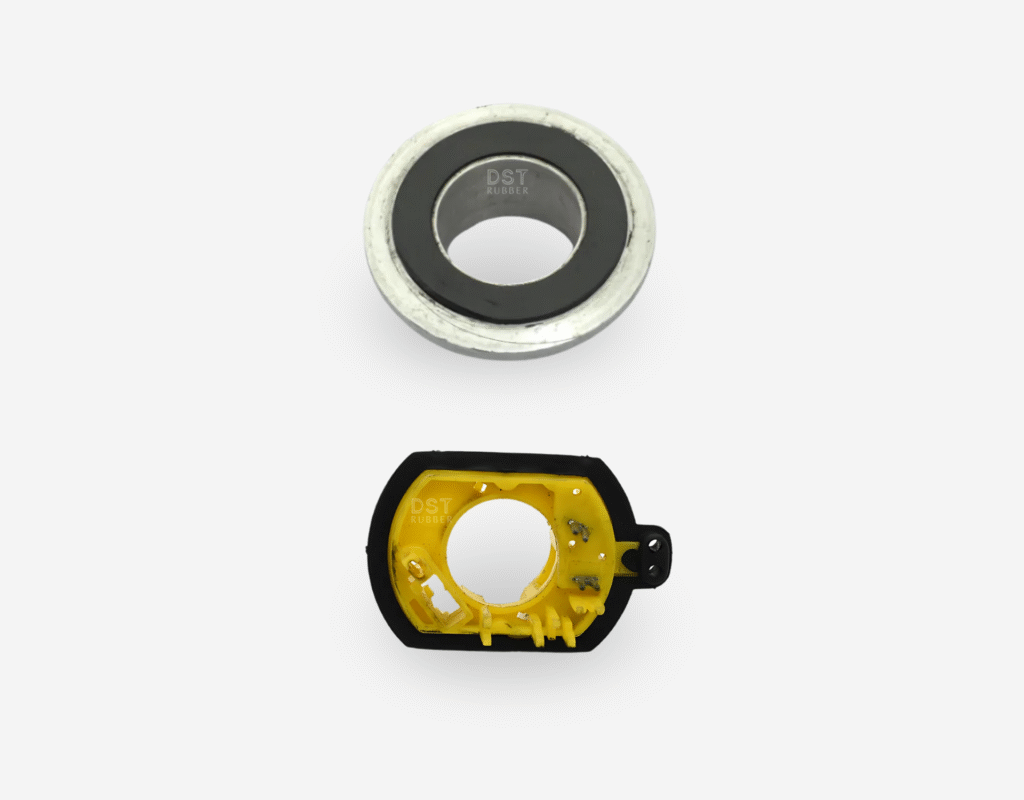
A large share of diaphragm replacement demand comes from legacy equipment where no drawing exists, only a worn physical sample. Ask whether the manufacturer can reverse engineer a diaphragm from a sample, including dimensional scanning and compound identification, and ask for a real example of this work.
6. In-House Testing: Burst Pressure, Cycle Life, Tear Resistance
A diaphragm’s real-world reliability comes down to three measurable properties: burst pressure (the pressure at which it ruptures), cycle life (how many flex cycles it survives before fatigue failure), and tear resistance (how well it resists point damage propagating into a full tear). Ask whether the manufacturer tests these properties in-house on every compound and construction, or whether they rely only on the raw material supplier’s published data. In-house testing is what catches a bad batch before it ships.
7. Industry Experience and Verifiable Case Studies
Ask for examples of diaphragms the manufacturer has supplied into your specific industry, whether that is automotive, pumps, valves and actuators, or renewable energy. A manufacturer with named OEM customers and documented case studies has already solved problems similar to yours. Review DS Rubber’s case studies and about us page for named customer relationships and project history.
8. Lead Time and Communication During Production
Ask how the manufacturer communicates during a production run: do they provide a defined point of contact, scheduled status updates, and a clear escalation path if a batch is delayed. Lead time quoted on a proposal is only useful if it is reliably met, and the best predictor of that is how organized the manufacturer’s process is before you place the order.
9. Cost Transparency and Total Cost of Ownership
The lowest quoted unit price is not the same as the lowest total cost. Factor in tooling amortization, MOQ-driven inventory carrying cost, failure rate and warranty terms, and the cost of a supply disruption if the manufacturer cannot flex on volume. A manufacturer willing to walk through these numbers openly is signaling confidence in their own quality data.
Questions to Ask Before You Send an RFQ
- What elastomer compounds do you formulate in-house, and can you share full physical property data for each?
- Which quality certifications do you hold, and can you provide current certificates?
- What is your typical tooling lead time for a new diaphragm mold, and can you produce a prototype first?
- What is your MOQ for a new custom part, and how does pricing change with volume?
- Can you reverse engineer a diaphragm from a physical sample with no drawing available?
- Do you test burst pressure, cycle life, and tear resistance in-house, and can you share test reports?
- Can you provide references or case studies from my industry?
- Who will be my point of contact during production, and how will delays be communicated?
Red Flags That Signal a Manufacturer Is Not Ready for Custom Work
- Vague or evasive answers about which specific compounds they formulate, versus a general claim of “we can make any rubber part.”
- No willingness to share test data or certification documents before a purchase order is placed.
- Tooling lead time quoted as a single round number with no explanation of what it includes.
- Reluctance to discuss MOQ flexibility, or pricing that barely changes between a 500-unit and a 5,000-unit order.
- No named references or case studies in your industry, only generic marketing claims.
Get a Diaphragm Spec Review From DS Rubber's Engineering Team
If you are evaluating suppliers against this checklist, DS Rubber’s engineering team can review your current diaphragm spec, whether it is a new design or a legacy part with no drawing, and provide feedback on material, tooling, and testing before you commit to an order. Explore the full custom rubber products capability or contact us to start a spec review.
FAQs
For automotive or safety-critical applications, look for IATF 16949. For general industrial applications, ISO 9001 is the baseline quality management certification to expect.
Tooling lead time varies by part complexity and manufacturer capacity, so ask for a specific timeline in writing rather than a general estimate, and confirm whether a prototype can be produced before full production tooling is committed.
Yes, an experienced manufacturer can reverse engineer a diaphragm from a physical sample through dimensional scanning and compound analysis. Ask for a documented example of this work before relying on it for your program.
Minimum order quantity affects both your upfront cost and your ability to start with a smaller pilot run before committing to volume. A manufacturer with rigid, high MOQs can be a poor fit for new or low-volume programs.
At minimum, burst pressure, cycle life (fatigue resistance), and tear resistance should be validated for the specific compound and construction you are ordering, ideally with in-house test data available on request.