

TL;DR -- Key Takeaways
- EV architectures shift the primary seal design driver from fuel/oil resistance to thermal management.
- Battery enclosure seals must handle thermal cycling, IP67/IP69 moisture ingress standards, and long-term compression set — with no planned service life replacement.
- This pushes many designs toward silicone and specialty EPDM over legacy NBR compounds.
- Compressed EV development timelines make supplier prototyping speed as important as compound selection.
- Audit every inherited NBR spec against new thermal/moisture requirements rather than assuming it transfers cleanly.
“EV programs didn’t just change the powertrain — they rewrote the sealing brief from scratch.”
— Suganthan, Director, DS Techno Rubber Private Limited
A Different Sealing Brief Entirely
Combustion-era seal specs were built around one dominant exposure: fuel and oil. Electric vehicle architectures replace that brief almost entirely. The gasket and seal market is being pushed toward improved thermal management specifically by the shift to electric vehicle architectures.
What Battery Pack Sealing Actually Demands
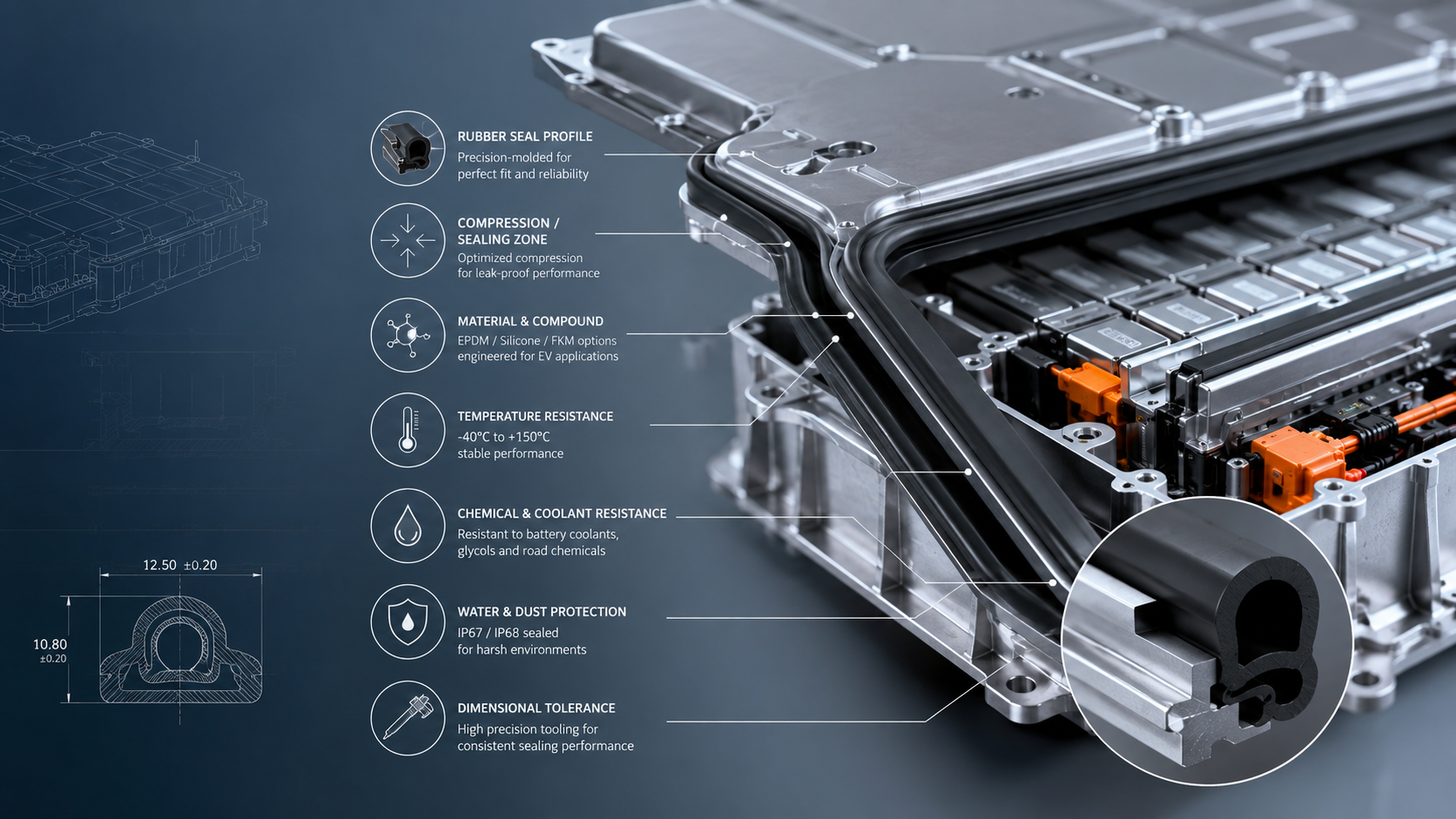
Battery enclosure seals need to manage several things at once:
- Sustained thermal cycling as packs heat and cool through charge cycles.
- Moisture ingress prevention, often to IP67/IP69 standards.
- Compression set resistance over the full vehicle service life, since these seals are rarely serviced.
ICE Sealing vs. EV Sealing: What Actually Changed
The table below contrasts the two design briefs directly.
The Manufacturability Problem EV Programs Create
EV development timelines are compressed relative to legacy automotive programs, which puts real pressure on how quickly a sealing supplier can move from a reverse-engineered prototype to validated production tooling.
| Requirement | ICE-Era Sealing | EV Battery/Motor Sealing |
|---|---|---|
| Primary exposure | Fuel, oil | Thermal cycling, moisture |
| Typical compound | NBR | Silicone, specialty EPDM |
| Ingress standard | Application-specific | Often IP67/IP69 |
| Service expectation | Periodic replacement common | Full vehicle life, no service |
Audit every seal currently specified in NBR against its new thermal and moisture-ingress requirements before assuming an inherited spec transfers cleanly to an EV platform.
Frequently Asked Questions
Why can't ICE-era rubber seals be reused for EV platforms?
EV seals face different thermal cycling and moisture-ingress demands, especially around battery enclosures, that legacy fuel-focused NBR compounds weren’t designed to handle.
What material is best for EV battery pack seals?
Silicone and specialty EPDM are common choices for thermal stability and long-term compression set resistance.